

Industry: Telecommunications
Client: Fortune 50 Telecom Provider in the US
Kenway's Role: Full-lifecycle routing architecture redesign: program and transition management, business analysis, solution architecture and development, quality assurance, and change management and training
Results: 57% fewer routing rules (1,072 eliminated) • 71% fewer routing flows and coding methodologies • up to 50% less analysis time for change requests • an estimated $150,000 saved in annual development costs
Contact centers succeed or fail in a single moment: whether a caller reaches the right representative on the first attempt. When they do, the issue gets resolved, operating costs stay contained, and the customer hangs up satisfied. When they do not, the call is transferred between agents, wait times grow, and that same customer often calls back. Industry benchmarks place first-call resolution at just 70 to 79 percent, which means roughly a fifth to a third of all calls require a repeat contact.
Every point of that metric carries a dollar value. Research from SQM Group finds that each one-percent improvement in first-call resolution corresponds to about a one-percent reduction in operating costs, worth an estimated $286,000 a year for a typical mid-size contact center. The mechanism that determines whether a caller lands in the right place is the routing architecture: the logic that interprets why someone is calling and directs them to the correct queue. Left unmanaged, that logic accumulates complexity and technical debt until even small changes become slow, risky, and expensive.
Kenway's client, a Fortune 50 telecommunications provider, serves millions of customers across a wide range of products and services, with its primary IVR handling more than 500,000 calls per day. Over years of customer growth, new product launches, and business reorganizations, the routing logic that supported those calls had grown organically and without a unifying standard.
That logic spanned two layers that had drifted out of sync: agent routing managed in Genesys, and department codes mapped through Cisco CTI. The result was a routing architecture that was difficult to understand, slow to change, and prone to inconsistency. Several distinct problems compounded one another.
Routing logic was spread across seven distinct routing groups, each built with its own coding methodology. To make a single change, a scrum team first had to understand the conventions of the specific flow involved, then trace the logic through multiple downstream decision points and code files. Because the files were organized by platform rather than by intent, the same rule frequently had to be coded in several different locations. A change for one product or caller type meant edits in multiple places, which introduced room for defects and meant callers with nearly identical needs could be routed differently.
The fragmentation created widespread duplication. Identical or near-identical rules lived in multiple code files, inflating technical debt and making the logic hard to document and harder to troubleshoot. When a queue saw an unexpected change in volume, investigators had to check several areas of routing to find the cause, lengthening resolution time. Layered on top of this were thousands of agent queues, many of which received little or no traffic. The IVR carried more than 4,000 agent queues at its peak, a number that scrum teams and analysts had to account for every time they touched the design.
Modern IVRs increasingly rely on natural language understanding to interpret why a customer is calling, which introduces new and sometimes unexpected values into the variables that drive routing. Kenway found cases where those variables were populated with invalid values, sending calls to the wrong place. Compounding this, design standards differed from one scrum team and code file to the next. Those small inconsistencies, while individually defensible, limited which teams could safely work in each area of routing and raised the risk of introducing new defects, creating key-person risk across the practice.
This engagement is a representative example of Kenway's Routing & Architecture Design expertise. Rather than impose a generic template, Kenway began by listening: conducting a thorough analysis of the existing routing architecture and the needs of every affected business unit, then designing a new structure aligned to the client's specific routing strategy.
Kenway analyzed every routing rule to identify where the same outcome was being produced by different logic, then consolidated those rules while guaranteeing that callers still reached the same set of agents as before. Working with technical stakeholders, the team standardized the various coding methodologies into a single, readable approach and moved routing into a common agent-routing framework. The consolidation reduced the number of routing flows and coding methodologies by 71%.
Routing rules and agent queues that no longer served live traffic were systematically retired in partnership with the client's stakeholders, with no queue removed without client approval. To support this, Kenway built a custom Power BI reporting framework that exposed call volume at the routing-rule level for the first time, giving designers the visibility to distinguish genuinely unused logic from rules masking a defect. The cleanup removed more than 1,000 routing rules, a 57% reduction.
Kenway established consistent naming conventions and design standards across all areas of routing, then made sure the people who maintain the logic could work within them. Before the new architecture took effect, the team ran live training sessions for business analysts and other maintainers, provided reference documentation, and communicated every upcoming launch in advance so stakeholders could prepare and raise concerns early.
With more than 500,000 calls flowing through the IVR each day, a poorly managed cutover could have stranded callers in loops, dropped calls, or triggered a wave of avoidable transfers. Kenway built a parallel test workflow that ran the new logic alongside the live system, showing where each call would have routed under the new design without affecting the caller's actual experience. Discrepancies surfaced and were corrected before launch; the team estimates this prevented issues that could otherwise have affected up to 180,000 calls per day from ever reaching production.
To manage residual risk, the team built a toggle system that could switch any rule between the legacy and new logic within minutes, and in later waves allocated traffic to the new design on a sliding scale from 0 to 100 percent. For queues expected to see shifts in call volume, Kenway provided the workforce management team with volume estimates ahead of each launch and adopted a phased rollout so agent centers could adjust staffing gradually.
Kenway delivered a streamlined routing architecture with far fewer decision points and no negative impact on where callers ultimately landed. The new design routes calls using 1,000+ fewer rules and 71% fewer routing flows, while preserving routing accuracy.
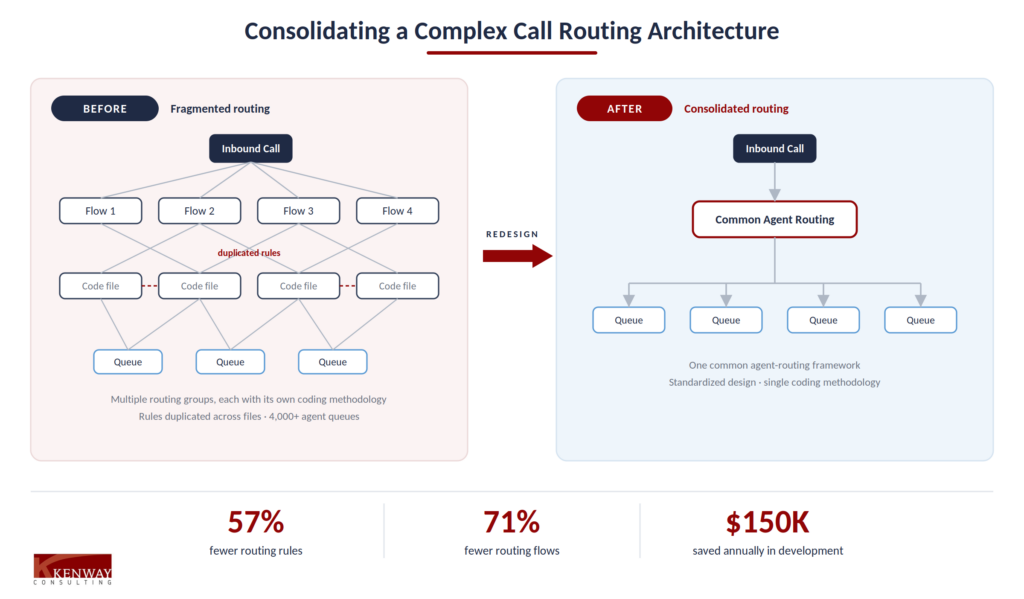
The simpler architecture is markedly easier to maintain. Analysis time for scrum teams and business analysts dropped by up to 50%, lowering technical debt and accelerating the weekly and monthly routing changes the business depends on. Conservatively, the new design is estimated to save more than 1,500 development hours each year. At an assumed $100 per hour, that is roughly $150,000 in annual development savings alone, before accounting for the additional savings from fewer misroutes, lower transfer rates, and less time spent investigating defects.
Just as important, the client is left with less to maintain: less duplicated code, less technical debt, and less of the tangled routing infrastructure that made every change harder than it needed to be. The routing architecture is now positioned to support future contact center initiatives rather than holding them back.
Ready to take the next step? If your call routing architecture has grown faster than your ability to maintain it, Kenway's Contact Center Solutions team can help you design a simpler, more reliable structure. Connect with us to get started.