

The Silent Bottleneck in Supply Chains
Picture a manufacturer waiting on critical parts to keep production running. The order is delayed, updates are inconsistent, and the customer service team is buried under calls. By the time the right people are informed, the damage is done: deadlines slip, costs rise, and customers are left frustrated.
This plays out every day in global supply chains, and the root cause is rarely the delay itself. It is broken supply chain communication. Companies invest heavily in eCommerce platforms, warehouse management systems, order management systems, and ERPs. But when those systems operate in silos, information stalls, blind spots appear, and breakdowns at integration points turn small hiccups into missed commitments.
The leaders who get ahead treat these moments differently. Instead of letting communication bottlenecks dictate performance, they invest in modern contact center solutions and use those moments to build speed, trust, and resilience.
Why Supply Chain Communication Matters More Than Ever
Supply chains are interconnected webs of suppliers, carriers, distributors, and customers. When communication fails, through missed updates, outdated tracking, or unclear ownership, the effects are costly. In a fast-moving environment, even a small lapse can stall production or cost millions. Clear, centralized communication is no longer optional. It is essential.
Recent industry reporting underscores the urgency. In Tive's State of Visibility report, a strong majority of supply chain professionals said real-time visibility is now a must-have, yet a large share of companies still have not implemented it. That gap between expectation and execution is exactly where communication breakdowns expose the business.
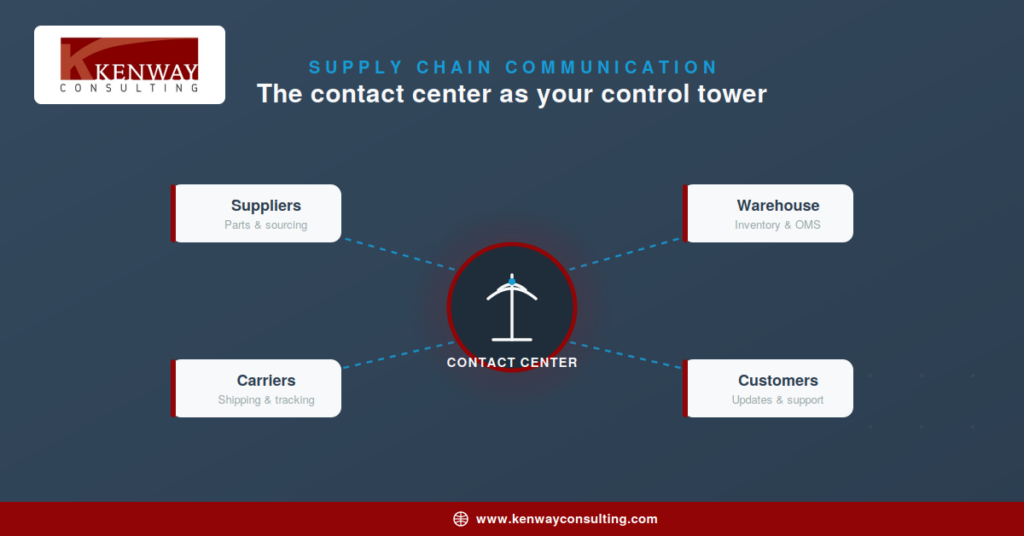
Traditional call centers were built to handle complaints and simple order inquiries. Modern supply chains need contact centers that connect directly to ERP, CRM, and order management systems. With those integrations in place, the contact center stops being a place that just answers phones and becomes a control tower, coordinating communication across every stakeholder in the chain.
Solutions for Modern Supply Chains
Modern contact centers strengthen supply chains not by adding more agents, but by deploying smarter technology. The priority is software that lets customers, vendors, and carriers get answers quickly and consistently across every channel.
In B2C supply chains, chatbots and voicebots can resolve routine questions such as order status, shipment tracking, and delivery updates around the clock. Automated scheduling lets customers adjust delivery windows without waiting for an agent, while online returns systems generate labels instantly and provide real-time tracking back to the warehouse.
In B2B supply chains, the same principles apply, but the "customer" is often another supplier or logistics partner. Consider a typical fulfillment chain: a company receives an order, notifies its third-party fulfillment vendor, and the vendor must then keep both the company and the end customer informed when the product ships. Without integrated systems and clear communication, delays and blind spots surface fast, eroding the customer experience and, over time, customer retention.
Equally important is making sure these tools deliver on their promise. Regular testing of voice and chatbots confirms that interactions feel natural, reduce frustration, and stay on brand. And when an issue needs to escalate to a live agent, integrated systems should pass along the full context of the conversation, so the customer never has to repeat themselves. Automation, integration, and disciplined testing together create a seamless experience for everyone in the chain, while reducing inbound call volume, shortening resolution times, and freeing agents for complex cases.
Industry Example: From Solutions to Strategic Advantage
A real-world example comes from Maersk, the global integrated transport and logistics company that operates in more than 130 countries with over 100,000 employees.
Maersk's contact center ran on a complex, expensive on-premises phone system stitched together from multiple Cisco platforms and third-party plugins. It lacked the flexibility a global brand needs, supervisors had limited visibility into call data and agent performance, and agents had to manually log the reason for each call, which produced inaccurate data and obscured customer trends. With roughly 15,000 configured agents and 2,750 concurrent agents across more than 120 countries, the team was facing an on-premises upgrade estimated at about $10 million.
Rather than pour money into legacy infrastructure, Maersk moved to a cloud-based platform, Cisco Webex Contact Center, working alongside managed-service partner Tata Communications. The team decoupled the contact center application from the underlying phone system so agents could log in from any location or device, and deployed 21 features on time and within scope. Webex Contact Center integrated with the systems Maersk already relied on, including Salesforce and ServiceNow, with roughly 90% of agents now using the Salesforce connectors. Supervisors gained granular, real-time reporting through Webex Analyzer, enabling faster, better-informed decisions.
The results were measurable. In the words of Steven Vickery, Maersk's Enterprise Voice and Contact Center Service Owner, the move to an evergreen cloud platform "massively saved us operational costs," at a fraction of the roughly $10 million legacy upgrade. With a single, flexible infrastructure in place, Maersk is now positioned to layer in AI capabilities such as topic analytics, agent assist, and conversational AI agents. (Source: Webex Blog: Maersk transforms global customer experience with Webex Contact Center.)
At Kenway, we stress that adding tools is not the end goal. The real impact comes from aligning people, processes, and technology so the contact center becomes a source of growth rather than simply an expense.
Building for Today and Tomorrow
Companies should start by identifying where communication fails today, then focus on solutions that integrate with existing systems, reduce repetitive work, and empower digital interactions. Metrics such as first contact resolution, order inquiry turnaround, and customer satisfaction keep progress measurable.
The strongest supply chains also prepare for what comes next. Predictive analytics will help anticipate disruptions before they cascade. Voice AI will deliver near-instant order updates. Automation will simplify returns and exception handling. And as sustainability rises in importance, contact centers will play a central role in sharing sourcing and impact data with customers and partners.
The organizations that succeed strengthen communication today while embracing the innovations that will shape tomorrow.
Strengthening the Backbone
Communication has always been the backbone of supply chains, yet too often it remains the weakest link. By modernizing contact centers with proven software, continuous testing, and practical tools such as order tracking, returns management, and vendor support, companies can improve efficiency, reduce costs, and strengthen resilience.
At Kenway Consulting, we help organizations diagnose where supply chain communication breaks down, design tailored solutions, and implement strategies that deliver lasting impact. Contact us today.