
It's the first Monday after your telephony cutover. The office opens on time, agents pick up calls normally, and the screen that has shown the caller's account for the last six years stays blank. Agents start asking customers for account numbers, search by name, pick the wrong John Smith, and apologize. Call notes that used to log themselves now get typed by hand. By mid-morning, handle time is climbing and someone from IT is asking a question nobody can answer: what happened? That is what a rushed response to the Salesforce Open CTI retirement looks like from the contact center floor.
Here's the part that should stick with you. Companies in this position usually described their telephony setup as simple, and they believed it. Nearly every company does, right up until someone asks a specific question about a specific behavior and the room goes quiet. Simple, applied to an integration that has been running for a decade, usually just means nobody has looked.
Salesforce Open CTI is the framework that connects a telephony or CCaaS provider to the Salesforce agent console, most often Service Cloud. It gives agents the ability to make and receive calls, trigger screen pops, log activities, and work customer records without switching applications.
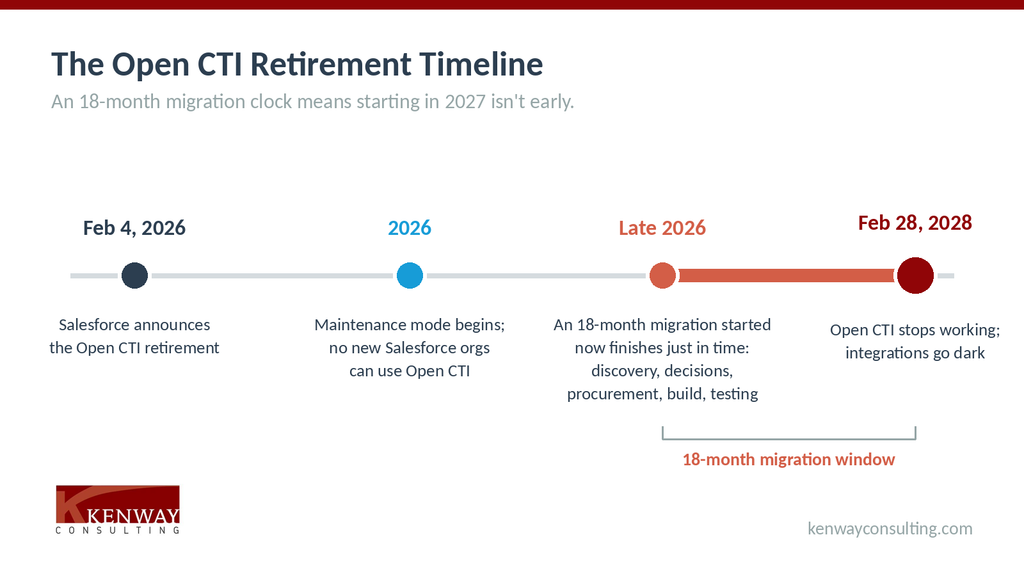
On February 28, 2028, that connection will stop working. Salesforce launched Open CTI 14 years ago, stopped enhancing it, and confirmed the date in its official retirement notice. Newly created Salesforce service orgs can no longer implement Open CTI, existing implementations run until the deadline, and nearly every third-party phone system connected to Salesforce runs through it. Open CTI has been a workhorse, but it was never built for the data-hungry, AI-driven contact center world companies operate in today. Salesforce's own migration guidance confirms the platform sits in maintenance mode until retirement, with no new features coming.
If this is the first you're hearing about it, you're in good company, and there are three reasons for that. First, it looks like an IT function, so a retiring API never reaches the leadership table as the customer experience issue it is. Second, everything works. The phones ring, the screens pop, the metrics flow, so nothing is ringing alarms. Third, February 2028 feels far away, with 20 more burning issues in front of it. It's a lot like holding a two-goal lead in hockey. The urgency is missing because the position feels safe.
The organizations that get hurt won't be the ones with the most complex systems. They'll be the ones where nobody pays attention.
Most partners will tell you the migration itself is straightforward, and connecting a CCaaS platform to Salesforce is well-understood work. Experience says otherwise. Kenway's Contact Center Solutions team ran one migration with no sandbox to test in and vendor documentation that was incomplete and, in places, just wrong. Every change had to be validated in production. It took far longer than anyone planned, and it changed how these projects get scoped.
An integration that's been running for years has years of decisions built into it: how calls are routed, which interactions open a case, what the agent sees when the call connects, and which calls get recorded for compliance. That logic was added one change request at a time, often by people who have since moved on. Some of it was never written down, and what was written down may not have survived the retention window. Rebuilding the integration means reconstructing business rules nobody recorded.
At another client, agents had been selecting a disposition code at the end of certain calls. Everyone treated it as clerical, a box to check before the next call. During discovery, Kenway found that code quietly fed the process that flagged calls for compliance review, and it wasn't documented anywhere. Rebuilding without it would have left the phones working perfectly while a regulatory obligation silently stopped being met. Nobody would have noticed until an auditor did.
That's the pattern. Loud breaks get fixed. Silent breaks are the ones that cost you.
Start with the math. A complex contact center migration runs eighteen months or more, including discovery, decisions, procurement, build, and testing. Work backward from February 2028, and starting in 2027 isn't early. You won't be alone, either. Every organization with a phone system connected to Salesforce is working against the same date, so implementation capacity gets scarcer and pricier the longer you wait, and your negotiating leverage with vendors shrinks.
The second argument matters more. Organizations that decide under deadline pressure replicate what they have because there's no time to question anything. The routing that frustrates customers gets rebuilt as is. The screen pop that shows agents the wrong information gets faithfully recreated. You spend real money to end up where you started. Organizations that move early treat the Open CTI retirement as a driver for change: they fix the friction customers already complain about and come out the other side with something better than what they had.
There are three realistic paths forward. Kenway's practice lead was one of the industry experts asked to weigh these options in CX Foundation's Salesforce Open CTI End of Life: What Are My Options? (recapped here on the Kenway site):
The right answer depends on your customer strategy, your current contracts, and your appetite for change, which is exactly why this decision belongs above the IT layer.
You don't need a budget line to get started, just a meeting with your IT, contact center, and customer experience leaders. Ask:
Teams that work through those questions early turn a forced migration into a planned one. They choose a platform on their terms, keep the business rules that matter, and walk into March 2028 with a contact center that serves customers better than the one it replaced.
The deadline has been set. The only open question is whether you meet it on your terms or the calendar's. To talk through where Open CTI sits in your environment and what your migration path could look like, contact Kenway's Contact Center and Salesforce practices.
Salesforce Open CTI Retirement FAQs
Open CTI retires on February 28, 2028. After that date, existing Open CTI implementations will no longer function.
Existing orgs continue to work until the retirement date, but Open CTI is in maintenance mode with no new features, and newly created Salesforce service orgs can no longer use it at all.
No. Partner telephony models let you keep your current CCaaS platform and reconnect it to Salesforce. The right path depends on your contracts, your compliance needs, and your customer strategy.