
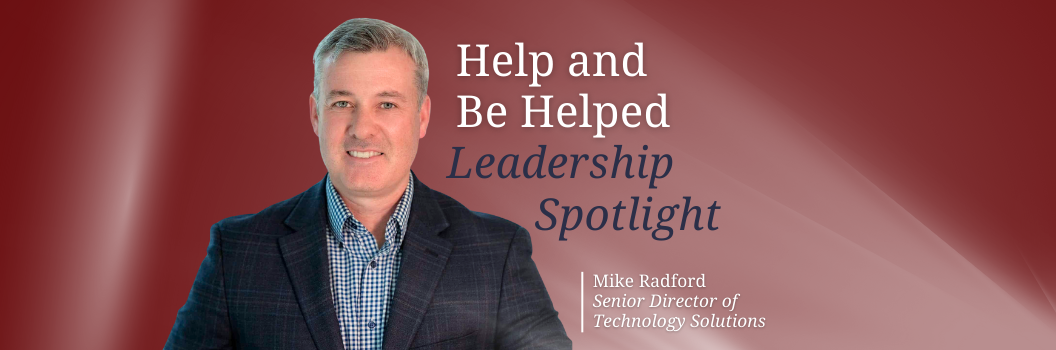
Mike Radford, Managing Director at Kenway, has been in consulting for 25 years. He's led complex technology transformations, built new practice areas, and guided teams through impossible problems. His leadership philosophy? Collaboration over competition, authenticity over hierarchy, and creating space for people to admit when they don't know something—because that's how the best solutions get built.
When Mike joined Kenway 11 years ago from Northern Trust, where he'd been a solution architect, the "Kenway Why"—to help and be helped—had recently been introduced.
"The 'to help' part felt natural and immediately aligned with my motivation to assist both Kenway and our clients," Mike explains.
But the "be helped" part? That was different.
"The 'be helped' was not something my prior employers had afforded me," Mike reflects.
It wasn't until a coffee meeting with Kenway's CEO that the realization hit: Kenway was also offering him a chance to be helped.
"Kenway provided many services in which I had very little experience or practical knowledge—Program Management, Business Process Redesign, Change Management," Mike says. "I saw the opportunity to accept this help and improve my consulting skills in these transformative areas—skills that have proven applicable to all my consulting projects since."
There's one word that describes Kenway's culture that Mike feels "we don't use a lot ourselves, but it's so true."
Authenticity.
Authenticity shows up in how leaders admit when they don't know something, how teams solve problems together, and how Kenway tells clients the hard truth instead of what they want to hear.
"I feel good about the fact that everyone treats each other as peers and colleagues first," Mike notes. “We view each other as peers, although we might have different scopes of accountability and responsibilities."
"We don't work in silos at Kenway," Mike explains. "We're so collaborative. There's a camaraderie there. And that sharing of knowledge and ideas and helping each other truly does produce better results for the client."
When faced with a uniquely challenging client problem with “no clear way to solve for it,” Mike leads by grounding the team in shared expertise.
“I have some ideas, but I also rely heavily on our teams to propose their ideas,” he says. Mike uses this mindset to reinforce a core cultural belief: the best solutions emerge when experts solve problems together. “It is very common to ask team members that are experts in the tech domain we're working in for their advice and input to help solve it.”
This approach reinforces confidence: Mike drives the work forward while intentionally tapping the specialists best equipped to build the strongest solution.
Mike is explicit about what his job is—and isn't.
"My job as a leader within Kenway is to coach others, grow others, help them along their career path," he says. "It's not to compete with them to prove that I'm a senior whatever role at Kenway."
This stands in stark contrast to how many consulting firms operate—where leaders compete for titles, billable hours, and credit.
That means creating conditions where junior consultants don't feel like they're wasting the client's time when they don't understand something. It means building support structures so no one feels isolated. It means listening to new ideas—even if they're not how Kenway has been doing things for the last 10 years.
Mike has learned something over 25 years in consulting: you can't sprint forever.
"It is consulting," Mike acknowledges. "There isn’t always a perfect 40-hour week."
But Kenway approaches workload differently. “You have real flexibility,” Mike explains. "There's going to be times when we're extremely entrenched in projects and we dig in. And then there's going to be slower times as well. And so that's the ebb and flow part of it, which makes it sustainable.”
One of the reasons people stay at Kenway—Mike has been there 11 years, many others 10+—is the entrepreneurial autonomy.
When Mike joined Kenway, he came from a pure technical background as a software architect. Kenway was a management consulting firm focused on program and project management and business analysis.
But over time, Kenway evolved. "Since I had such an in-depth software engineering background, eventually we started offering different things to the market when our clients would come to us and say, 'Hey, do you do this?'"
Now Kenway has a data and analytics practice, a Salesforce practice, and contact center capabilities. "We've greatly shifted what we offer to the market.” That's not just good for employees. It's good for clients. "Over time we've added more employees, more diverse skill sets, experiences, and we've morphed what we offer in terms of our services."
Mike Radford doesn't lead through hierarchy or titles. He leads through authenticity and collaboration.
"I don't know the best way," Mike says when facing complex problems. And then he asks his teams for their ideas—because they might be as good or better than his.
That's not just good leadership. That's how you build a culture where people stay 10+ years. Where collaboration beats competition. Where no one's afraid to say, "I need help."
Help & Be Helped isn’t just a philosophy — it’s how we lead at Kenway. Connect with Mike Radford on LinkedIn or read more stories of how Kenway brings Help & Be Helped to life on our Insights page.