
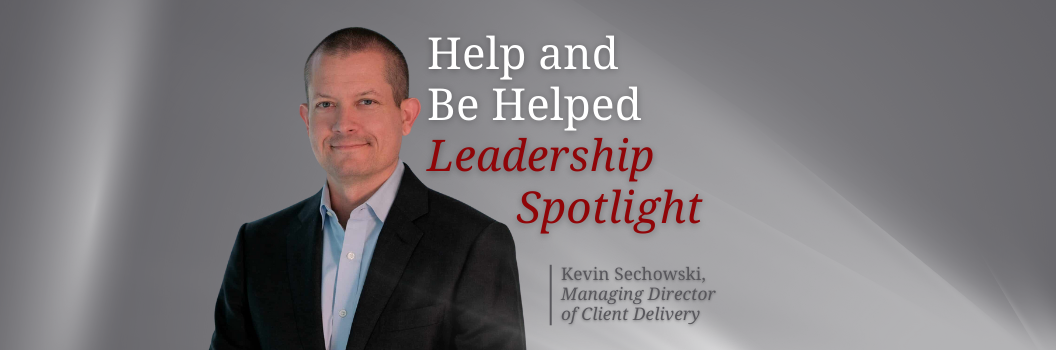
Kevin Sechowski spent the first decade of his consulting career focused on technical excellence. Then his trusted network left, his responsibilities grew, and he realized something critical: without people skills, success is fleeting.
Kevin Sechowski was about two years into his career at Accenture when he got feedback from his career counselor, Matt Kueker, that would take him a decade to fully appreciate.
"He praised me for my technical skills, but then highlighted all the soft skills I needed to build—executive presence, verbal and written communication, coaching, team building, leadership," Kevin recalls.
Kevin's response? "Admittedly, I somewhat ignored it at first and continued my focus on technical skills."
He wasn't being stubborn. He just didn't see the need yet.
Then reality started shifting beneath him.
"It was probably just a few months after I got that feedback from Matt that Brian King left," Kevin explains. Brian was going off to do something else—specifically, to start Kenway Consulting.
About six months later, Matt decided to go back and get his MBA.
Then, maybe six to twelve months after that, Amy Ehrmantraut left to join Brian at Kenway.
"There are new people coming in.
That's when Matt's feedback clicked.
"Building or showcasing more than just these—at that time, really strong—technical skills, I realized I needed to have those other things to establish that trust."
Technical excellence isn't enough when you're starting from scratch with new people. Relationships matter. Communication matters. Trust matters.
"I'll admit that it took probably a good ten years into my career before I realized that while my focus on so many projects is on process and technology, the difference maker comes down to people, and without those soft skills, success is fleeting," Kevin says.
As the responsibility and breadth of what I was accountable for grew, I realized I couldn't just brute force—get something across the finish line and get it done."
"It didn't matter how beautiful the process flow was or how correct it was or whether the software did what it was supposed to. It's about moving from control into more influence. Trying to move three people versus 100 people—it's a lot more about the people than anything else."
Years earlier—probably 15 years ago now—Kevin was at a business development meeting at Abbott Laboratories. Kenway was small at that point, maybe 10 people. This opportunity mattered.
"It was a big deal because at that size, they didn't come across that often."
But to understand what happened next, Kevin needs to go back even further.
"I had a fear of public speaking. I would actually say it's more being the center of attention," Kevin explains.
At that Abbott Labs meeting, Kevin was the data expert. They wanted answers to some questions. The table then turned to him. Kevin recalls, "I was stumbling all over the place. Not making any sense."
The next day, Brian King stopped by Kevin's desk.
"He said, 'Hey, you want to talk about that opportunity?' I said, 'Sure.' Brian continued, 'How do you think that went?'"
Kevin knew it was awful. "I said, 'It was okay, but there were some things I could do differently. Maybe phrase it this way or that way.'"
Brian cut through it. 'Yeah, that wasn't very good.'"
But here's what matters: Brian didn't focus on how poorly it went.
"He basically turned it more into a discussion of, 'Look, we're 10 people now. Here's all these wonderful things you're doing for the company. Here's where we're going to be at some point in the future. Crossing this bridge is a huge part of us getting to that point.'"
"I was like, 'Okay, that was a gut punch,'" Kevin admits. "But it resonated because it was very much about helping me. And I had to be humble enough to accept that help because I had the same vision of what Kenway could become."
Brian's suggestion? "I think what you should do is actually take improv classes."
Kevin's internal reaction: "In the back of my mind, I'm thinking, 'No effing way.'"
But he did it anyway. A year of improv training at Second City, which included three performances on the main stage. The absolute hardest part? Musical improv!
"What was wild was the first time the spotlight was on me in the first class—it was the first time, but also the last time it was terrifying."
That doesn't mean it's easy now. "Doing all that is still uncomfortable. I've just gotten comfortable with that discomfort."
Kevin carries that experience with him in how he leads teams today.
"I focus first on the problem, without judgment, and how we can get to a solution, always willing to jump in and help without casting any blame," he explains. "After we are in a better spot, we can dig into constructive feedback."
It's the approach Brian modeled: acknowledge the reality, focus on the path forward, frame it as help.
The lesson stuck. When people need help, you don't pile on shame. You focus on the problem and how to solve it together.
Outside of work, Kevin has two outlets that help him recharge and think differently.
Running: "Running is my therapy and is where I often do some of my deepest thinking and resetting. Even more so when I do it without any headphones or music.
DIY projects: "In a job and role that often deals with more abstract, intangible things—or when outcomes on client projects often aren't clear until after we've completed our scope of work—DIY projects give me the outlet to work on very tangible things and see the outcome.”
Both recharge him in different ways.
"Up until the end of my freshman year of college, I wanted to be an optometrist," Kevin shares. "I ended up pursuing business and tech because it seemed like it was more exciting and in constant change. I ended up going down the consulting route because I wasn't entirely sure what I wanted to do and thought it would be a good way to see a bunch of different companies and give me some time to figure out what to do long term."
Twenty-four years later, he's still here.
Kevin Sechowski spent a decade learning what Matt Kueker told him in year two: technical skills will only get you so far.
"The focus on so many projects is on process and technology," Kevin reflects. "But the difference maker comes down to people. And without those soft skills, success is fleeting."
Kevin learned it the hard way, and through help. A culture where asking for help isn't weakness—it's how you grow.
That's the model Kevin carries forward now: focus on the problem, not the person. Jump in to help without blame. Get to a better spot first, then dig into feedback.
Because technical excellence isn't enough. It never was.
Help & Be Helped isn’t just a philosophy — it’s how we lead at Kenway. Connect with Kevin Sechowski on LinkedIn or read more stories of how Kenway brings Help & Be Helped to life on our Insights page.