

Most organizational change management programs treat resistance as a communication problem. Send more updates, host another town hall, publish another FAQ, and employee adoption will follow. That assumption skips over what actually determines whether a transformation sticks: how well the people leading it manage emotions, both their own and everyone else's. Emotional intelligence in change management is not a soft skill tucked into the corner of a project charter. It is one of the clearest predictors of whether an initiative delivers on its business case at all.
Prosci's research on project sponsorship makes the point concretely. Projects with highly effective sponsors are roughly three times more likely to meet their objectives than projects with ineffective ones. The technical plan rarely fails on paper. It fails when the people responsible for carrying it out cannot read the room, manage their own frustration, or keep a sponsor engaged past the kickoff meeting.
Executives usually don't struggle to build a case for change. They struggle to sustain organizational change. A recent Gartner survey of HR leaders found that most report their employees are fatigued from constant change, and a similar share say their managers are not equipped to lead through it. That gap between plan and practice shows up as quiet resistance: employees who nod in the town hall and keep working the old way, managers who avoid hard conversations about what the change actually requires, and sponsors who go quiet after the announcement.
The frustration this creates for leaders is real. A team can build a defensible business case, secure funding, and still watch adoption stall because nobody addressed how the change would feel to the people living through it. Technical readiness and emotional readiness are different problems, and only one of them shows up in a project plan.
Kenway's Business, Product, and Digital Transformation practitioners see this pattern across manufacturing floors, back offices, and executive suites alike. Organizations don't come to Kenway because they lack a plan. They come because they need practitioners who notice when a department is overwhelmed, know how to keep a sponsor visible past kickoff, and can translate resistance into information the project team can act on.
Psychologist Daniel Goleman's framework breaks emotional intelligence into five components, and each one shows up directly in how a transformation plays out.
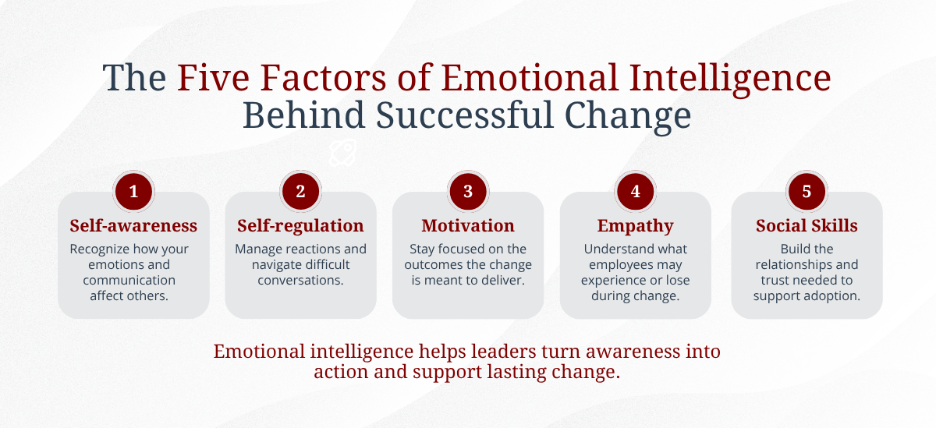
Kenway adds a sixth element when working inside a live transformation: turning that awareness into action on a timeline. Empathy that never becomes a revised rollout plan, an adjusted training schedule, or a harder conversation with a sponsor doesn't move employee adoption on its own.
Emotional intelligence in consulting shows up in decisions that never make it into a status report. A consultant with strong self-regulation stays in a difficult stakeholder meeting long enough to understand the objection instead of steering around it. One with strong social skills notices that a quiet manager's silence in a working session isn't agreement, and follows up privately. These are small moments, but they compound. Understanding these dynamics early can also give leaders a clearer picture of change readiness across teams and stakeholders.
Organizations that treat change management as a purely technical discipline often measure the wrong things: training completion rates, communications sent, milestones hit on a project schedule. Employee adoption depends on something harder to schedule: whether people trust the process enough to change their behavior once the project team moves on to the next phase.
Leaders don't need a psychology background to put emotional intelligence to work in a transformation. A few habits make the biggest difference:
Treat resistance to change as information. A pattern of pushback usually points to a gap in the plan, not a gap in employee buy-in.
None of these require new software or a bigger budget. They require leaders willing to slow down enough to notice what is happening on the ground.
Organizations that skip this work tend to discover the cost later rather than sooner. Adoption looks fine at go-live and erodes over the following two quarters as workarounds creep back in. Sponsors who were never coached to stay engaged move on to the next priority. The technology or process change survives on paper while the old way of working survives in practice, and the business case behind the investment never fully materializes.
Transformations that build emotional intelligence into the plan look different from the outset. Leaders address resistance in the room instead of letting it surface as attrition six months later. Employees experience change as something being done with them, not to them. The result is adoption that holds after the project team disbands and a transformation that keeps delivering value long after the go-live date has passed.
If your organization is planning a transformation and wants the people side built in from day one, schedule a consultation with Kenway's Business, Product, and Digital Transformation practice.
Emotional intelligence helps leaders recognize and respond to the human side of organizational change. Skills such as self-awareness, empathy, and communication can help leaders build trust, address resistance, and support employee adoption throughout a transformation.
Emotional intelligence helps leaders treat resistance to change as useful information rather than simply a barrier. By listening to employee concerns, recognizing what teams may feel they are losing, and adapting communication accordingly, leaders can identify gaps in the change approach and respond more effectively.
Five key emotional intelligence skills can support successful organizational change: self-awareness, self-regulation, motivation, empathy, and social skills. Together, these skills help leaders navigate difficult conversations, maintain stakeholder engagement, build trust, and support lasting behavior change.
Leaders can strengthen employee adoption by involving employees early, listening for both concerns and silence, keeping executive sponsors engaged beyond kickoff, and acknowledging both the gains and losses associated with change. These practices can help employees feel involved in the transformation rather than feeling that change is simply happening to them.