

In the modern data landscape, organizations across manufacturing, distribution, and beyond are sitting on more data than ever before. ERPs capture every transaction, WMS platforms track every pallet, and AR/AP subledgers record every invoice. The raw material for extraordinary business intelligence certainly exists – but the challenge is building an AI-ready analytics stack that turns this fragmented operational data into trusted, actionable insight.
Most organizations trying to deploy AI analytics today are making the same fundamental mistake: layering AI on top of a broken data foundation. Sophisticated AI interfaces produce unreliable outputs because the underlying data is unstructured, untested, ungoverned, and inconsistently defined. As expected, a CFO who gets a working capital figure from an AI tool that contradicts what Finance produced last week will never trust that tool again.
The solution is to build a better data foundation before investing heavily across various AI models. To achieve this, this post will examine how a modern transformation and semantic governance tool like dbt can be leveraged within a medallion data architecture to build a single, verifiable source of truth.
Why Traditional Analytics Pipelines Are Not AI-Ready
For most traditional operations, the typical analytics pipeline looks like this:

On the surface, this works. But underneath, several things are quietly going wrong:
When you connect AI to this foundation, it produces answers that look authoritative but cannot be verified. That is more dangerous than having no AI at all. This is the problem the modern analytics stack solves.
The AI-Ready Data Architecture: Three Layers, One Foundation
The architecture that makes AI-ready analytics possible has three distinct layers, each with a clear responsibility.
Data Platform – Storage and Compute
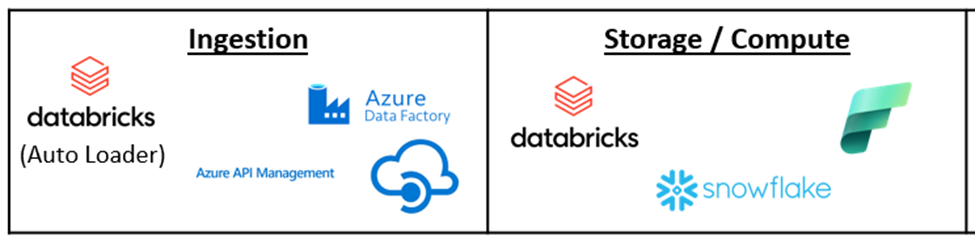
This is where data lives. Databricks with Delta Lake provides ACID transactions, schema enforcement, and platform-level governance via Unity Catalog. Alternatives include Snowflake, Microsoft Fabric, Azure Synapse, and others as the right choice depends on your existing ecosystem.
Transformation – dbt Labs
This is where raw data becomes governed, analytics-ready tables. While data platforms offer native transformation utilities, such as Microsoft Fabric’s visual Dataflows or Databricks’ notebook environments – they often force a trade-off between low-code isolation and complex engineering overload.
dbt bridges this gap by introducing software engineering discipline to SQL development. It manages all transformation logic using modular models, enforces dependency order, generates lineage automatically, runs automated data quality tests, and publishes a live data catalog. Organizations that cannot staff robust engineering teams to build out complex transformation pipelines, manage workflow orchestration, and maintain stable development environments can benefit significantly from dbt. Critically, dbt is platform agnostic – the same models run on Databricks, Snowflake, or Fabric by swapping a single configuration file.
AI or BI Consumption – The Semantic Layer
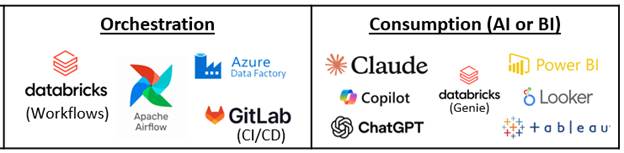
This is where business users interact with the governed data. Rather than connecting AI tools directly to messy databases, the modern stack uses traditional BI tools (like Power BI and Tableau) or next-generation LLM frameworks to sit on top of a fully verified data layer.
What makes this architecture powerful is not any single component. It is the combination of governed data feeding a flexible consumption layer that produces something neither could achieve alone. In our next post, we will explore how next-generation protocols can eliminate the traditional dashboard lifecycle here.
Why dbt Matters for Data Governance and AI Readiness
For organizations evaluating transformation tooling, the natural question is: why dbt over native platform tooling? Databricks has Delta Live Tables. Snowflake has dynamic tables. Fabric has Dataflows. Why add dbt?
The answer is governance: specifically, the engineering disciplines dbt enforces structurally rather than through conventions that erode under deadline pressure.
No native platform offers these capabilities together. That is the dbt case.
The Medallion Architecture in Practice
The medallion architecture maps naturally to how dbt organizes transformation work.
The result is a layered pipeline where every transformation decision is documented, tested, and traceable – where any downstream consumer, whether a BI dashboard or an AI model, queries the same governed definitions.
Data Platform Selection
The most important point about platform selection: dbt is the constant. The data platform is variable.
Databricks is the strongest choice for organizations with ML and AI ambitions, streaming data requirements, or a preference for open-source tooling. Snowflake fits organizations whose primary workload is structured analytics and BI. Microsoft Fabric is the natural choice for deeply Microsoft-native organizations already investing in Azure and M365.
The dbt governance story: lineage, testing, documentation, modularity – is identical regardless of which platform sits underneath it. Platform selection should be driven by workload, ecosystem fit, and cost model. Transformation governance should not be part of that decision.
The Speed-to-Value Advantage
A production-grade implementation of this stack consisting of ten source tables, a full medallion architecture, and over eighty automated data quality tests could be built by a small team in a matter of weeks. Not months. Not a multi-million-dollar program. Weeks.
For mid-market manufacturers and distributors who have been told that enterprise-grade supply chain analytics requires enterprise-grade investment, that timeline and cost profile changes the conversation entirely.
The organizations that will win the AI analytics race are not the ones with the most sophisticated AI models. They are the ones with the cleanest, most trusted, most accessible data. AI is the interface. The governed data foundation is what makes it reliable.
Build the foundation right, and AI becomes a force multiplier. Skip it, and AI becomes a liability.
Frequently Asked Questions
What is an AI-ready analytics stack?
An AI-ready analytics stack is a governed, modern data architecture that ingests, transforms, tests, and documents enterprise data. It provides the structured foundation required for business intelligence (BI) and Large Language Models (LLMs) to draw from consistent, trusted definitions across the organization.
Why is data governance important for AI analytics?
AI analytics depends on reliable underlying data. Governance practices such as lineage, automated testing, documentation, and standardized metric definitions help reduce inconsistent or unverifiable AI outputs.
What is a medallion data architecture?
A medallion architecture organizes data into Bronze, Silver, and Gold layers. Bronze preserves raw source data, Silver cleans and standardizes it, and Gold applies business logic to create analytics-ready data for downstream BI and AI consumption.
How does dbt support AI-ready data?
dbt acts as the transformation and governance engine inside your data platform. It enables teams to write modular, version-controlled code, automatically test data quality, generate end-to-end lineage, and enforce consistent business metrics across the entire enterprise.
How does an AI-ready analytics stack accelerate M&A and ERP consolidation?
The same governed architecture required for AI is what makes post-merger integration possible. By unifying disparate transactional systems into a centralized medallion structure, organizations can harmonize metrics across acquired entities, maintain real-time working capital visibility, and capture post-close deal synergies faster.
Kenway Consulting's Data & Analytics and Artificial Intelligence practices specialize in building governed, AI-ready analytics foundations.
Ready to transform your data infrastructure and realize the full ROI of your AI investments? Contact us to learn more about how we can help your organization turn raw data into trusted, real-time insight.