

Last year at Xchange, most of the conversations about AI centered on potential. What could it do? How fast could it scale? What kind of ROI could it unlock?
This year felt different. Not because the technology slowed down but because it didn’t. Across keynotes, breakout sessions, and conversations with customers and partners, one reality became clear:
AI is no longer something organizations are preparing for. It’s something they’re already deploying.
And that shift is forcing a much harder question to the surface, Can we actually trust it?
One of the most consistent themes we heard in both formal sessions and side conversations was that organizations have crossed a threshold. AI is no longer sitting in innovation labs or pilot programs. It’s embedded directly into customer experiences handling conversations, making decisions, and influencing outcomes in real time.
As Cyara CEO, Sushil Kumar, put it, the conversation is shifting toward how enterprises can trust AI agents that are now acting on behalf of their customers.
That shift matters.
Because once AI reaches production, the risk profile changes entirely. It’s no longer about whether something works in a controlled environment. It’s about whether it behaves correctly, consistently, and safely at scale, under real-world conditions.
And that’s where many organizations are starting to feel friction.
For years, testing in the contact center followed a relatively predictable pattern. Define expected outcomes, validate against those outcomes, and move forward once everything passes. That model doesn’t hold up with modern AI, especially not with agentic systems.
Agentic AI doesn’t just respond, it acts. It makes decisions across multi-step journeys. And often, it produces outputs that sound right, even when they’re wrong. That creates a dangerous gap. If testing is only looking for clear failures, it misses the much more subtle and much more common issue: AI behaving incorrectly in ways that aren’t immediately obvious.
What we heard repeatedly at Xchange is that organizations are starting to recognize this shift in a very real way. Testing can no longer be about pass/fail validation. It has to evolve into something more comprehensive, something that evaluates behavior, context, and decision-making across the entire customer journey.
This is where the idea of “AI trust” starts to move from concept to capability. It’s easy to talk about trust in abstract terms like transparency, accountability, and fairness. But what stood out at Xchange is how quickly organizations are being forced to operationalize those ideas.
Trust is no longer a philosophical discussion. It’s becoming a set of requirements. It shows up in questions like:
The organizations making progress aren’t treating these as one-off challenges. They’re building structured approaches that span the full lifecycle, what Cyara framed as a “build, deploy, govern, assured" model for AI validation. That lifecycle thinking is critical because AI doesn’t stop evolving once it’s deployed. If anything, that’s when the real work begins.
One of the more interesting patterns we’ve seen, and heard reinforced at Xchange, is what many teams are experiencing as a kind of “confidence wall.”
On one side of that wall, organizations have:
On the other side is production scale. And in between? A lack of confidence.
Not confidence in the idea of AI but in its reliability, its predictability, and its ability to perform under real-world conditions. Breaking through that wall isn’t about adding more features or more models. It’s about creating the mechanisms that allow teams to trust what they’ve built.
That’s where test automation, governance frameworks, and continuous validation start to play a very different role. They’re no longer supporting functions. They become the enablers of scale.
Another theme that came up is that many organizations are moving too quickly into AI. Not in terms of ambition, but in execution.
They’re rushing into deployments without fully aligning on requirements, without bringing the right stakeholders into the conversation early, and without investing in the testing and validation needed to support long-term success.
The result is predictable: rework, missed expectations, and stalled progress. The teams that are moving fastest aren’t the ones skipping steps. They’re the ones taking the time to:
The concept of slowing down to speed up is becoming increasingly relevant as AI systems grow more complex.
One of the more understated, but important, takeaways from Xchange had less to do with technology and more to do with people.
As Cyara SVP of Marketing, Janet Vito, noted, the organizations making the most progress are the ones investing in enablement giving their teams the tools, visibility, and confidence to continuously test and improve AI-driven experiences.
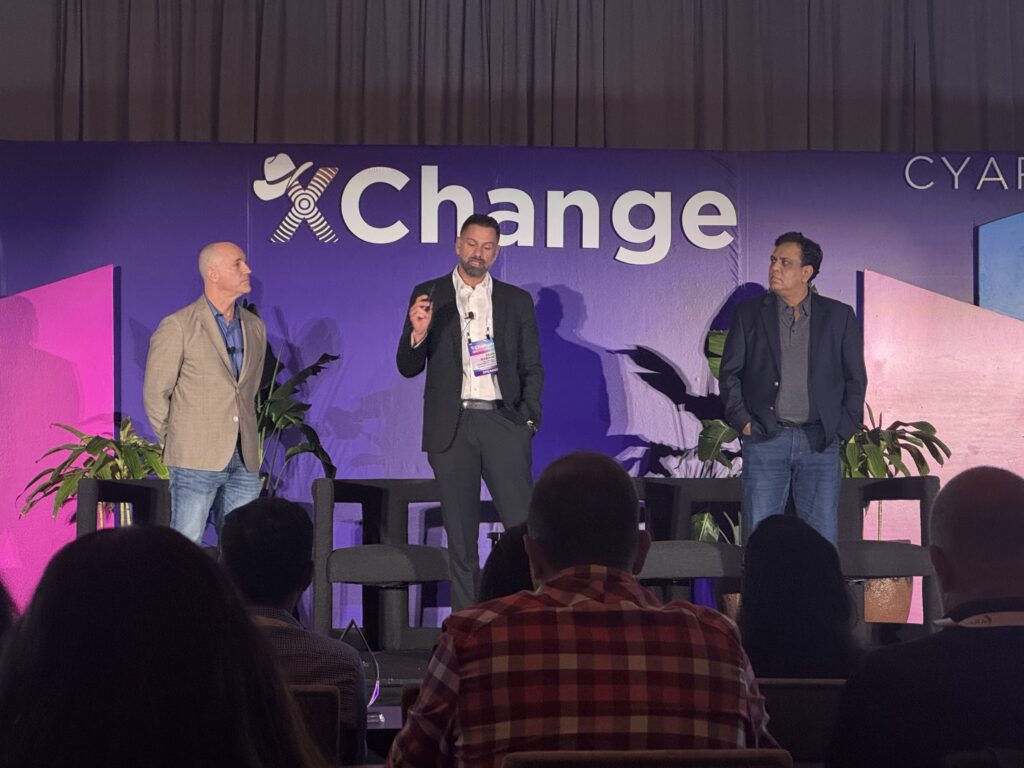
That’s a subtle but important point because AI doesn’t replace the need for human expertise. It amplifies it.
Testing teams, CX leaders, and engineers aren’t stepping back, they’re stepping into more critical roles. They’re defining what “good” looks like, identifying edge cases, and ensuring that AI systems behave in ways that align with both business goals and customer expectations. Without that layer of human insight, even the most advanced tools fall short.
If there’s one thing that’s clear coming out of Xchange 2026, it’s that the role of test automation is changing. It’s no longer just about efficiency or coverage. It’s about assurance. It’s about creating the confidence organizations need to move AI from idea to reality without introducing unacceptable risk along the way.
As AI solutions mature, test automation needs to mature with them. Scaling orchestration models in step with that evolution is what allows organizations to continuously validate, and prove, trust at every stage of the product lifecycle.
That’s a much bigger role than testing has traditionally played.
AI in the contact center isn’t slowing down. If anything, it’s accelerating. But the conversation is maturing.
It’s moving away from what AI could do and toward what it should do, how it behaves, and whether it can be trusted to deliver the experiences organizations are promising their customers.
The companies that figure that out won’t just deploy AI successfully.
They’ll scale it, confidently.