
Key Deadline: Salesforce will retire Open CTI on February 28, 2028. No new features or enhancements are being added to the framework. Contact centers that rely on Open CTI today need a migration plan — and the time to start is now.
Salesforce has officially placed Open CTI in maintenance mode, with a retirement date of February 28, 2028. For organizations that rely on Open CTI to connect Salesforce Service Cloud with telephony platforms like NiCE, Five9, Genesys, Amazon Connect, Cisco, and others, this is not just a technical sunset. It forces organizations to make a decision.
The contact center has fundamentally changed since Open CTI was designed. Customers expect seamless omnichannel service. Agents need real-time context when a call arrives. Leaders need visibility across every interaction not just call logs. Salesforce is increasingly positioning voice as a native, data-rich service channel through Salesforce Voice and Agentforce Contact Center, and the message is clear: the legacy Open CTI model is not the future.
February 2028 gives organizations time to plan thoughtfully. But many contact centers have complex telephony environments, custom routing logic, call center adapters, reporting dependencies, compliance requirements, and operational processes deeply embedded in their current Salesforce CTI integration. Waiting too long transforms a strategic modernization opportunity into a costly, rushed technology replacement.
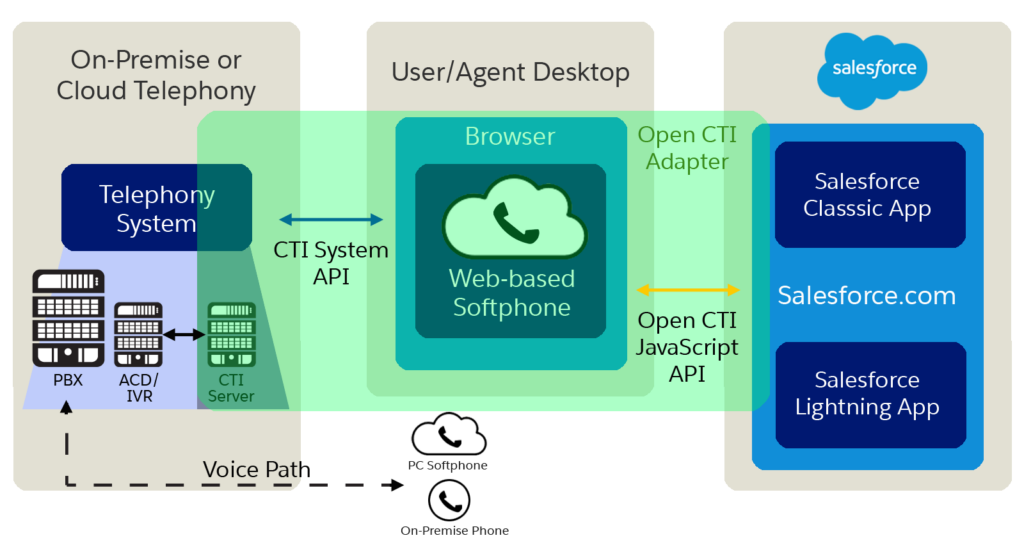
Salesforce Open CTI is a JavaScript API framework that enables computer telephony integration inside Salesforce without requiring desktop software. In practical terms, it allows a third-party telephony or CCaaS provider to surface inside the Salesforce agent console, giving agents the ability to make and receive calls, trigger screen pops, log activities, and interact with customer records without switching applications.
For many organizations, Open CTI became the connective tissue between Salesforce Service Cloud and the contact center platform. It worked, but it was never designed for the AI-powered, omnichannel, data-driven contact center environment that enterprises are building today.
That is why the Open CTI retirement is not simply a question of replacing an adapter. It is a question of deciding what your next-generation Salesforce contact center architecture should look like, and who you want to be as a service organization.
When Salesforce Open CTI reaches end of life, every organization using an Open CTI-based integration will need a new path for connecting telephony and Salesforce. Salesforce has been explicit: retirement is set for February 28, 2028, and no new features or enhancements are coming to the framework before then.
For contact center leaders, this immediately surfaces four questions that cannot be deferred:
The instinct for most technology teams will be to frame this narrowly: "We need to replace Open CTI before February 2028." That’s accurate but incomplete.
A more productive way to look at it is the Open CTI retirement is an opportunity to modernize how voice works inside your Salesforce-powered contact center and to close gaps that have existed for years.
At Kenway, we see this pattern frequently. Organizations pursue the newest platform or bolt on automation without first addressing the structural issues underneath: siloed operations, fragmented data, inconsistent reporting, and a voice channel that was never truly integrated with the broader service experience. Our Contact Center Solutions practice helps clients use moments like this one to reimagine the contact center as a strategic hub, one that aligns technology, data, people, and customer outcomes.
The organizations that extract the most value from this transition will use it to answer questions they have been deferring:
The terminology can be disorienting. Organizations are simultaneously hearing about Service Cloud Voice, Salesforce Voice, BYOT, BYOC, Agentforce Voice, and Agentforce Contact Center often in the same conversation. Here is what each path actually means.
Salesforce Voice (previously marketed as Service Cloud Voice) is Salesforce's modern approach to making telephony a native part of the Salesforce service experience. Rather than treating voice as a separate system that loosely connects to Salesforce, Salesforce Voice embeds phone calls directly into the agent workspace, customer record, and service process with real-time AI transcription, automation, and agent assist capabilities built in.
This path allows organizations to Bring Your Own Telephony (BYOT) and connect Salesforce Voice with their preferred CCaaS or telephony provider (e.g. NICE, Five9, Genesys, Vonage, etc.). It is the most common migration path for organizations that want to modernize the Salesforce voice experience without replacing their existing contact center platform or renegotiating current contracts. This is particularly relevant for organizations with complex global routing, specialized compliance requirements, or large-scale contact center platforms they are not yet ready to replace.
Salesforce also offers native packages with Amazon Connect, making this an attractive option for organizations already invested in AWS infrastructure or evaluating Amazon Connect as part of a broader cloud strategy. Pre-built integrations reduce implementation complexity and accelerate time to value.
Agentforce Contact Center represents Salesforce's vision for an AI-first contact center, unifying voice, digital channels, CRM data, and AI agents in a single platform. It is built around AI-powered self-service, intelligent handoffs between AI agents and human agents, and real-time visibility across all customer interactions.
For some organizations, Agentforce Contact Center is the long-term destination. For others, it is a capability to evaluate alongside a near-term Salesforce Voice migration. Either way, the Open CTI retirement should trigger a serious conversation about where AI fits in your contact center roadmap not just where your telephony adapter is going.
February 2028 sounds distant. It is not. Contact center migrations are rarely straightforward, and the complexity is almost never in the licensing or configuration. It lives in the discovery, alignment, design, testing, change management, and operational readiness work that most organizations significantly underestimate.
Open CTI integrations accumulate technical debt over time. Screen pops, call logging, activity records, call center definition files, custom Lightning components, AppExchange packages, and reporting logic often depend on the current integration in ways that are not documented and only surface when something breaks.
Voice is not an isolated system. It is woven into service workflows. A change to the telephony integration can ripple through case creation, customer identification, routing logic, escalation paths, wrap-up codes, quality monitoring, compliance workflows, and supervisor reporting. Understanding the full impact before you begin is essential.
A like-for-like migration is sometimes the right call. But organizations that use this moment only to replicate what exists will miss the real opportunity. If customers still repeat themselves on transfers, agents still lack context at the start of a call, or supervisors still cannot see what is happening in real time the migration will be technically complete and operationally disappointing.
Open CTI sits at the intersection of multiple teams: Salesforce admins, contact center operations, telecom, enterprise architecture, security, data, and vendor partners. Without a clearly designated owner and a shared governance model, decisions stall and timelines compress in ways that eliminate good options.
Voice migrations are high visibility. When screen pops fail, calls misroute, recordings do not attach, or agents cannot disposition calls correctly, the operational impact is immediate and highly visible. End-to-end testing covering routing, screen pops, IVR data transfer, recording links, reporting, AI transcription, and failover needs to be built into the plan from the beginning, not added at the end.
The migrations that go well start with a strategy-first assessment, not a technology selection. At a high level, that means:
Kenway Consulting brings both strategic advisory and hands-on delivery to contact center modernization. We work at the intersection of Salesforce, contact center operations, and customer experience, which means we can help you navigate the technology decision and the business transformation at the same time.
Our Contact Center Solutions practice partners with clients on the full arc: footprint assessment, future-state architecture, platform-agnostic vendor evaluation, Salesforce Voice and Agentforce Contact Center implementation, and the operational outcomes that follow.
Ready to assess your Open CTI exposure and build a migration roadmap? Let's talk.
The Salesforce Open CTI retirement is not just a technical deadline. It is an opportunity to rethink how voice fits into your Salesforce ecosystem, your contact center strategy, your AI roadmap, and your customer experience.
Organizations that begin now will have the time to assess their options thoughtfully, align their stakeholders, avoid rushed decisions, and build a more modern, scalable, data-rich contact center. Organizations that wait will find themselves replacing technology under pressure with fewer choices and less room to improve what actually matters.
If your contact center runs on Salesforce Open CTI today, the time to act is now not because the deadline is imminent, but because the organizations that start early are the ones that finish well.
Salesforce Open CTI will retire on February 28, 2028.
Organizations typically evaluate Salesforce Voice, BYOT/Partner Telephony, or Agentforce Contact Center depending on their architecture and AI strategy.
Yes. Salesforce has shifted branding from Service Cloud Voice to Salesforce Voice.
Yes. Salesforce Voice supports BYOT (Bring Your Own Telephony) integrations with providers like NICE, Genesys, Five9, Amazon Connect, and others.
Most enterprise migrations take 12–18 months when discovery, design, testing, change management, and deployment are included.