

Industry: Telecommunications
Client: Fortune 50 Telecom Provider in the US
Kenway's Role: Full-lifecycle CCaaS migration support: program and product management, business analysis, solution architecture and development, quality assurance, subject matter expertise, and Data & Analytics
Results: A unified customer experience delivered on time and within budget, the legacy vendor contract retired on schedule, and millions of dollars in annual savings
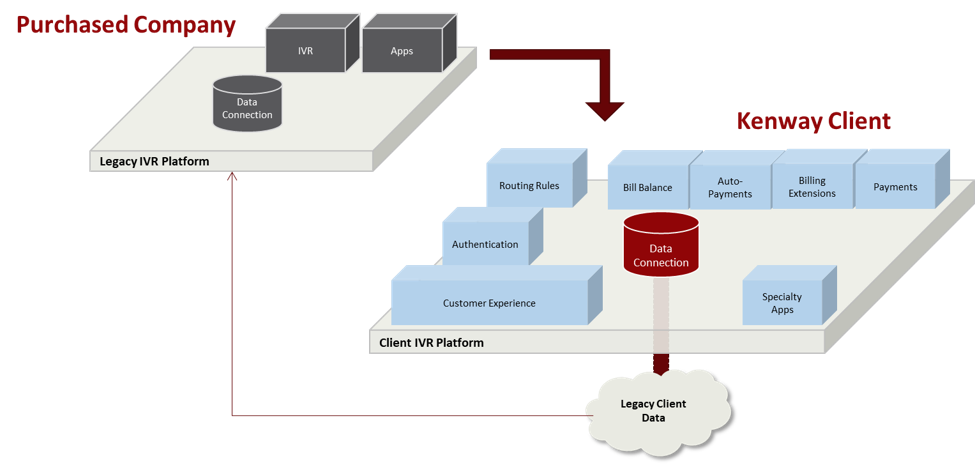
When a Fortune 50 telecommunications provider acquired another company, it inherited a second IVR platform that overlapped with its own, and the legacy system had to be retired without disrupting the customers who relied on it. The provider brought in Kenway's Contact Center Solutions practice to consolidate those experiences onto its target platform, work that spanned the full lifecycle of a CCaaS migration: current-state analysis, development, testing, and reporting. As enterprises move onto cloud contact center platforms and prepare for conversational voice and AI, retiring and unifying older systems this way has become a common starting point.
The provider needed to move several legacy experiences onto its current IVR platform so it could sunset the legacy system. The target platform already ran many applications, some overlapping with the legacy side, and the legacy IVR pulled data from systems the target platform was not yet connected to. Before any integration could happen, Kenway had to identify the gaps between the two systems. As the client evaluated the affected areas, four obstacles defined the effort:
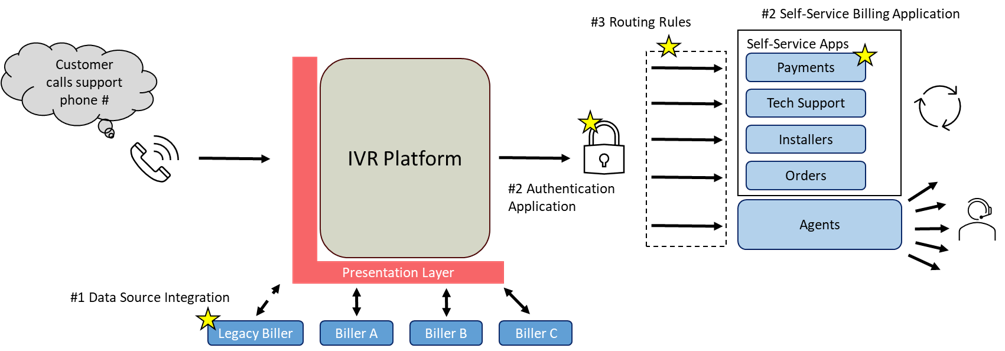
Kenway worked with client leadership to build a program roadmap with multiple workstreams. Given the tight timeline and the size of the program, Kenway supported the primary IVR and API integration, designed and implemented the routing rules, and developed both the payments and authentication applications.
A CCaaS migration of this scale is rarely a single skill set. Kenway supported the program across every discipline it required:
Kenway structured the work with program management and Agile methodology, dividing the build into two-week sprints and releasing frequently so the client could give feedback early. Several workstreams progressed in parallel, which kept the program on schedule.
Kenway’s analysts documented each legacy flow and ran discovery and design sessions with the client to confirm alignment before rebuilding a single application. Where the existing experience had gaps, the team designed a better solution and wrote requirements for future enhancements instead of carrying old limitations forward. Solution Architects and Developers built the new call flows using BPMN in Camunda, Drools business rules, and Java, validating each component with JUnit testing as it was built. Analysts confirmed functionality in System Test and again in UAT, an environment that mirrors production, verifying for example that a customer payment processed correctly, applied to the right balance, and was recorded on the account.
Identifying legacy customers correctly was critical to accurate routing. The team onboarded the APIs that connect back-end systems to the platform and applied standard data integration and ETL practices to parse and present that data for the IVR framework. For each API status code, the team wrote a response so analysts could see why an integration was failing and resolve it quickly. Additional analysis and testing covered the APIs tied to remitting and clearing payments, confirming that customer accounts updated correctly.
The client’s primary goal was to contain more callers inside the IVR, which reduces unnecessary agent interactions and shortens wait times for the callers who do need a person. Kenway reviewed the legacy routing, defined a new schema that fit the target design, and built screening rules to segment callers and route the right ones to self-service or to the correct agent. The team also designed specialty applications for direct-dial functions and managed the migration of nearly 4,000 toll-free numbers, throttling volume from the legacy flow to the new flow incrementally to protect the experience during cutover.
The legacy vendor’s platform offered little in the way of reporting. Kenway’s Contact Center Solutions and Data & Analytics practices worked together so that consolidating onto the target platform routed every interaction through one reporting infrastructure rather than a vendor’s limited tooling. Leadership gained a consistent, trustworthy view of how the IVR was performing and where to invest next, the foundation any organization needs before adding conversational voice or AI-driven automation.
Programs of this size are never frictionless. Legacy documentation was outdated or missing, so when it could not answer a question, the team performed its own data discovery and read source code line by line. Persistent API authentication issues were resolved by engaging the client’s security team to uncover internal firewall requirements no one had documented. Compliant test data was scarce because the client had no robust test data management, so the team worked around external dependencies to validate every payment scenario.
Kenway delivered a fully integrated customer experience, on time and within budget, that matched or exceeded the legacy system. Consolidating onto a single platform produced measurable improvements:
With the applications running, calls routing correctly, and every toll-free number migrated, the client ended its legacy vendor contract on time and saved millions of dollars annually. Just as important, the team could maintain and keep improving the entire experience on its own, with no outside vendor required.
To see how Kenway’s Contact Center Solutions experts can support your CCaaS migration or legacy IVR retirement, connect with our team.